EN
EN

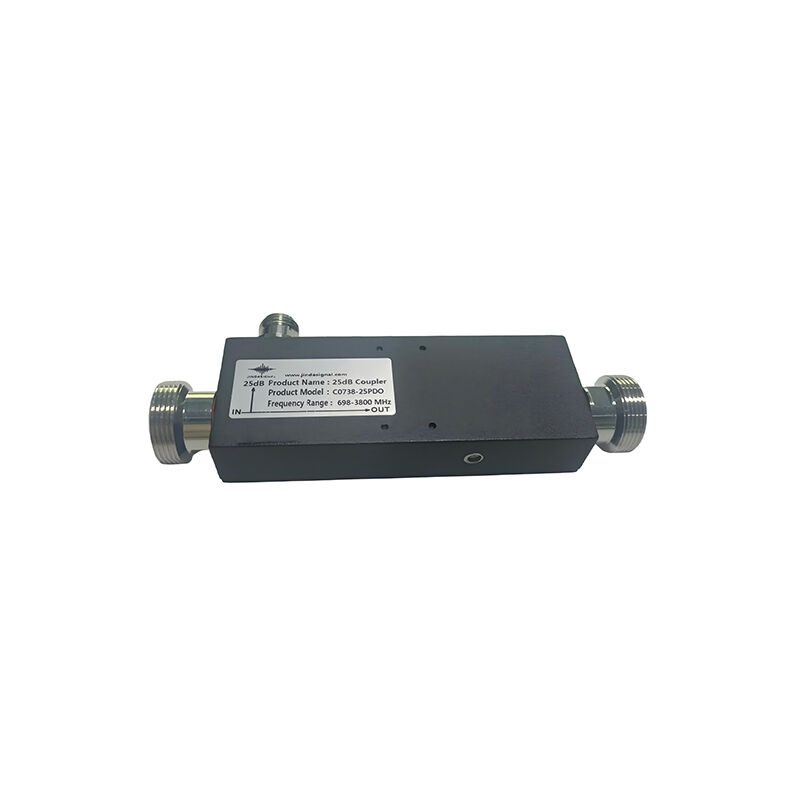
25dB Directional Coupler (D-D-N)-F 698-3800MHz
Product Model : C0738-25PDO
The Cavity Coupler is a high-performance passive RF device used for signal coupling and power distribution in wireless communication systems. Its primary function is to extract a portion of the signal power from the main transmission path to a coupled port, enabling signal monitoring, power splitting, or signal sampling while maintaining very low intermodulation distortion. It is widely used in base stations, repeaters, In-Building distribution systems, and other scenarios to ensure signal transmission quality and system stability. The Cavity Coupler offers excellent performance in low intermodulation (PIM), low insertion loss, and high power handling, making it suitable for wireless network optimization, In-Building Distribution Systems (IBS), Base Transceiver Stations (BTS), Distributed Antenna Systems (DAS), and Antenna Feeder System (AFS).
Product Description
♦ Wide bandwidth, Applicable to 5G band
♦ Low insertion loss
♦ Low PIM
♦ Small volume, Light weight
♦ Higher power capacity
♦ Application for indoor and outdoor humid environment using.

- Specifications
- Outline Drawing
- Applications
- Recommended Products
Specifications
| Frequency range | 698-3800MHz |
| Coupling | 25 dB |
| Coupling Loss | ±0.3 dB |
| Insertion Loss | ≤0.3 dB |
| Isolation | ≥43 dB |
| VSWR | ≤1.3 |
| Inter-modulation IM3 | ≤-160/-155/-150dBc REV (2x43 dBm) |
| RF Input Power, CW | 300W |
| Impedance | 50Ω |
| RF Connector Type | DIN F--DIN F--N F |
| Net Weight | ≤0. 43 kg |
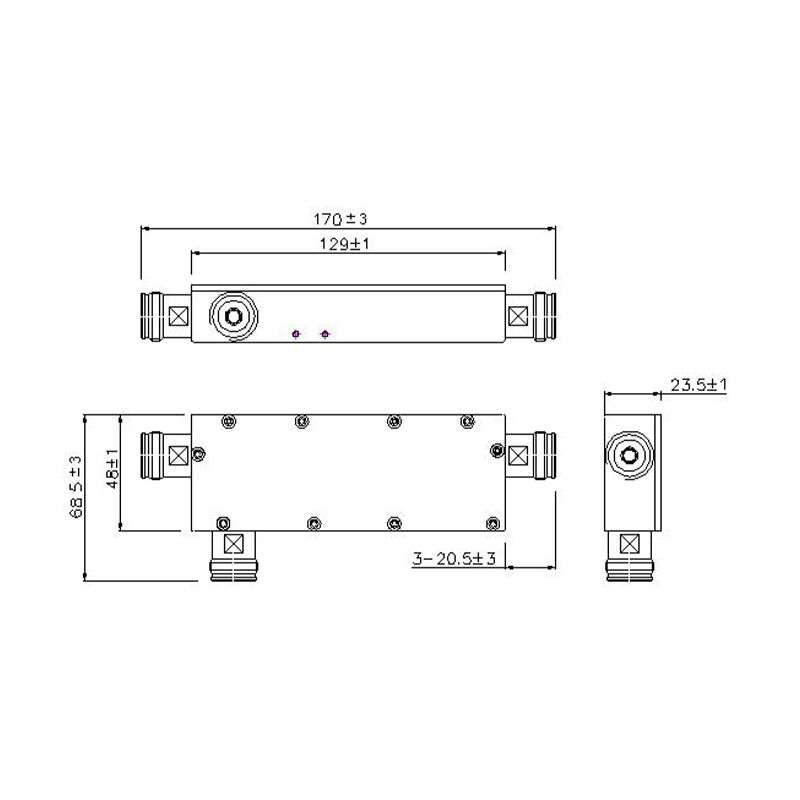
| Dimensions (include connectors) | 170*68*24 mm /6.69x2.68x0.94 inch |
| Operating temperature | -25℃ to +70℃ |
| Relative humidity | ≤95% |
| Color | Black or Custom |
| RoHS | Comply with RoHS |
| Ingress protection | IP65 |
Product Selection
| Part No | Inter-modulation IM3 |
| T11H220018-1 | -160dBc REV (2x43 dBm) |
| T11H220018-2 | -155dBc REV (2x43 dBm) |
| T11H220018-3 | -150dBc REV (2x43 dBm) |
Outline Drawing

Applications
Product Description of Cavity Coupler
The Cavity Coupler is a high-performance passive RF device used for signal coupling and power distribution in wireless communication systems. Its primary function is to extract a portion of the signal power from the main transmission path to a coupled port, enabling signal monitoring, power splitting, or signal sampling while maintaining very low intermodulation distortion. It is widely used in base stations, repeaters, In-Building distribution systems, and other scenarios to ensure signal transmission quality and system stability. The Cavity Coupler offers excellent performance in low intermodulation (PIM), low insertion loss, and high power handling, making it suitable for wireless network optimization, In-Building Distribution Systems (IBS), Base Transceiver Stations (BTS), Distributed Antenna Systems (DAS), and Antenna Feeder System (AFS).
Product Functions
1. Signal Coupling and Power Distribution
· Achieves power distribution between the main signal and coupled signal, supporting signal monitoring, sampling, and analysis.
· Ensures low-loss transmission of the main signal and high isolation of the coupled signal to meet various power distribution requirements.
2. Enhanced System Reliability and Stability
· Extremely low intermodulation distortion (IMD) avoids spurious signal interference and ensures inter-system isolation.
· Improves signal transmission quality and enhances communication stability and network reliability.
3. Optimized Network Resource Allocation
· Supports multi-band and multi-system access, compatible with mainstream communication standards.
· Provides precise data support for signal monitoring, power control, and fault diagnosis.
Product Features
1. Ultra-Low Intermodulation Distortion (IMD)
· Utilizes high-quality cavity structure and precision manufacturing processes, with typical third-order intermodulation (IM3) products as low as -160 dBc @ 2×43 dBm, far exceeding industry standards.
· Effectively suppresses spurious signals and prevents system interference.
2. Excellent Electrical Performance
· Low insertion loss and high coupling accuracy ensure efficient signal transmission and sampling.
· High isolation ensures independent and stable operation of the main and coupled signals.
3. High Reliability and Stability
· All-metal cavity structure provides strong shielding and outstanding anti-interference capability.
· Passive design with no active components ensures low failure rates and long service life.
4. Flexible Scalability and Compatibility
· Supports multi-band and multi-system access, compatible with mainstream communication standards such as 2G/3G/4G/5G, Wi-Fi, and IoT.
· Multiple coupling values available, supporting cascaded expansion to meet diverse scenario requirements.
5. Easy Installation and Maintenance
· Compact design, small size, and lightweight for easy installation and deployment.
Application Scenarios
1. Base Station and Repeater Systems
· Used for signal monitoring, power control, and fault diagnosis to enhance system stability.
2. In-Building Distributed Systems (IBS&DAS)
· Deployed in large buildings such as shopping malls, office towers, airports, and subway stations for signal sampling and monitoring.
3. Microwave and Satellite Communication
· Enables signal power distribution and combining to ensure long-distance communication quality.
4. IoT and 5G Communication
· Supports multi-band and multi-mode signal processing to meet high-speed, low-latency requirements.
5. Test and Measurement Equipment
· Used for calibration and testing of RF systems to ensure equipment performance meets standards.
Summary
As a core passive device in wireless communication networks, the Low-Intermodulation Cavity Coupler significantly enhances network reliability and stability through efficient signal coupling and power distribution. It effectively reduces signal interference, optimizes resource allocation, and is widely applicable across various communication scenarios. Its high reliability, ultra-low intermodulation distortion, and excellent performance make it an essential guarantee for the efficient operation of modern communication systems.