EN
EN

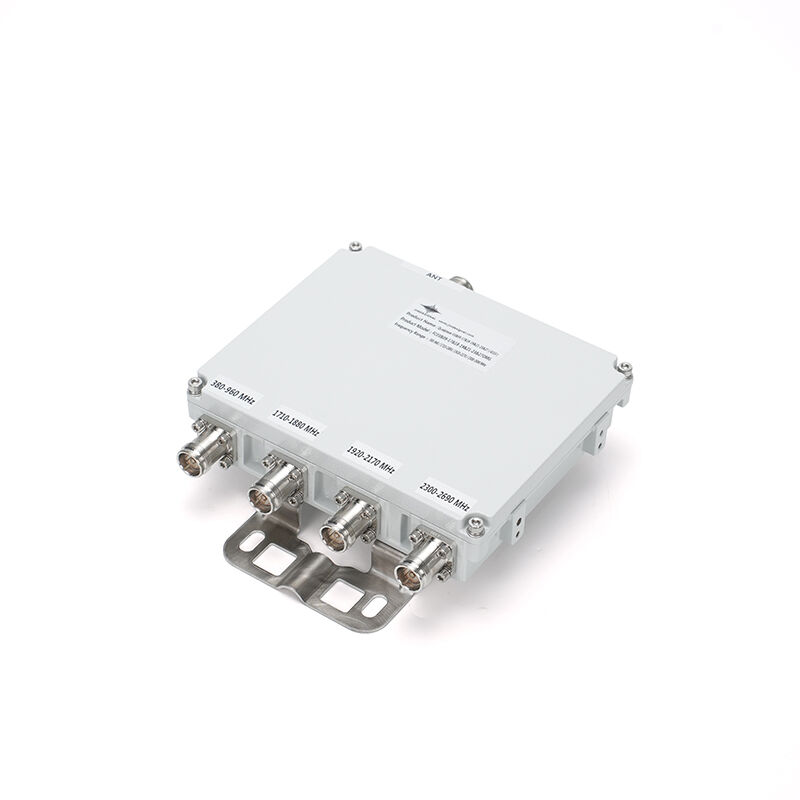
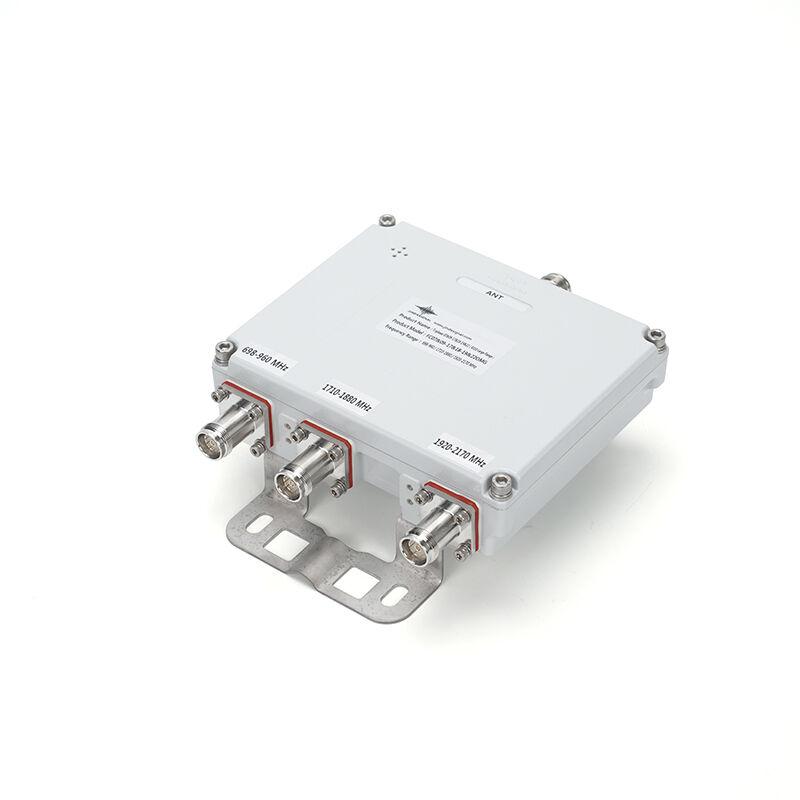
RF Combiner Quadplexer 380-960 / 1710-1880 / 1920-2170 / 2300-2690MHz
Product Model : FC 03&09-17&18-19&21-23&27
The combiner is the key RF device to combine multi-band signals in communication system. It is primarily employed in transmitters to combine signals from different frequency bands into a single feeder or antenna, thereby conserving resources and improving system efficiency. The combiner demonstrates excellent performance in terms of low passive intermodulation (PIM) products, low insertion loss, and high isolation, making it suitable for wireless network optimization, In-Building Distribution Systems (IBS), Base Transceiver Stations (BTS), Distributed Antenna Systems (DAS), and Antenna Feeder System (AFS).
Product Description
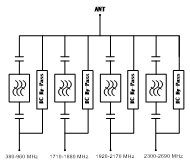
♦ Frequency covers 380-960 / 1710-1880 / 1920-2170 / 2300-2690MHz
♦ Pole or wall mounting
♦ Low PIM
♦ Suitable for indoor and outdoor applications

- Specifications
- Block Diagram
- Outline Drawing
- Applications
- Recommended Products
Specifications
| Frequency range | 380-960 / 1710-1880 / 1920-2170 / 2300-2690MHz |
| Insertion Loss | < 0.3 dB |
| Isolation | ≥50 dB |
| Return Loss | ≥19 dB |
| VSWR | ≤1.25 dB |
| Inter-modulation IM3 | ≤-155dBc REV (2x43 dBm) |
| RF Input Power, CW | 300W |
| Impedance | 50Ω |
| Lightning Protection | 3kA; 10/350 μs pulse |
| Net Weight (Single Unit) | ≤2.42kg |
| Net Weight (Double Unit) | ≤4.69kg |
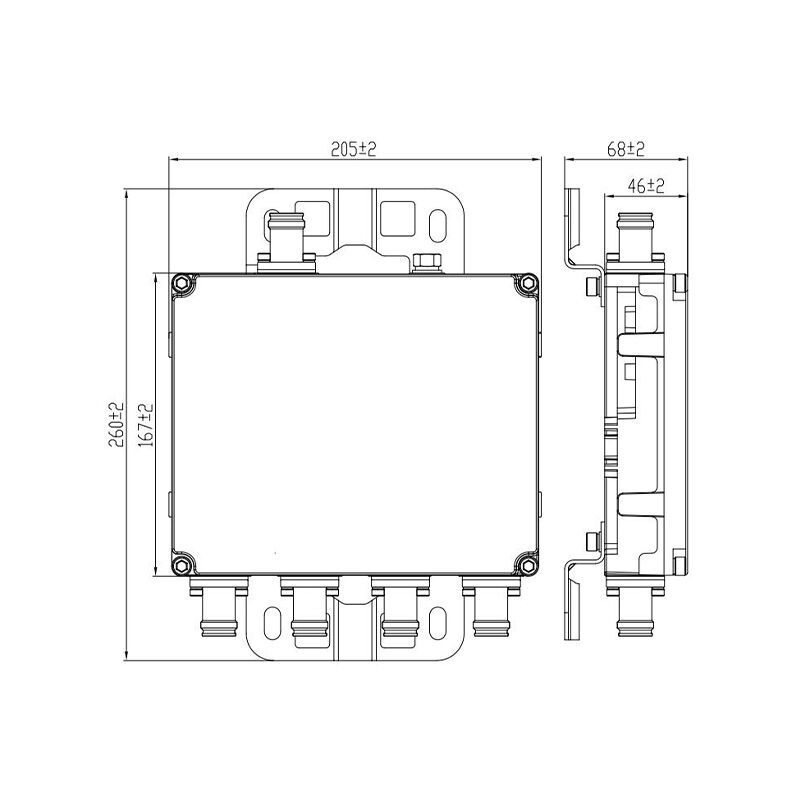
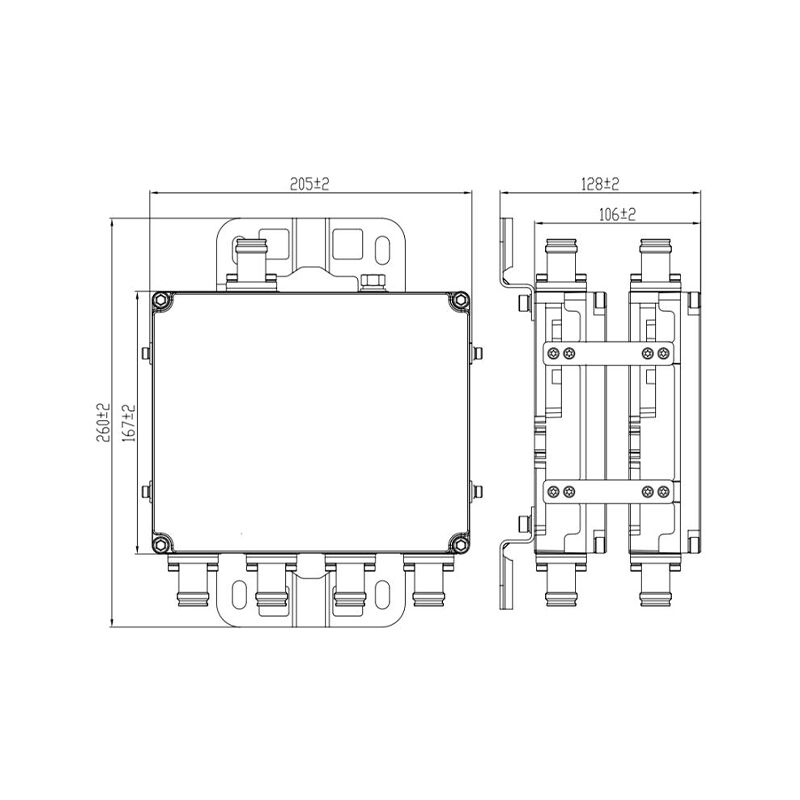
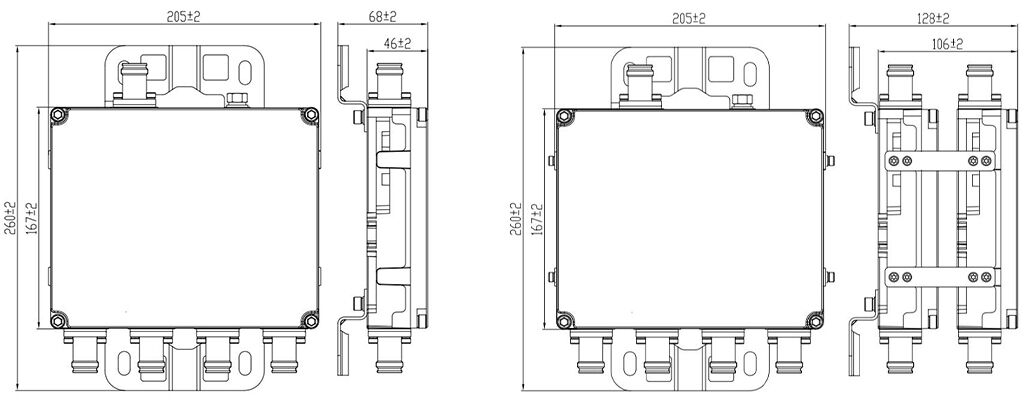
| Dimensions (Single Unit) (exclude connectors) | 205 x 167 x 46 mm /8.07x6.57x1.81 inch |
| Dimensions (Double Unit) (exclude connectors) | 205 x 167 x 106 mm /8.07x6.57x4.17 inch |
| Operating temperature | -40℃ to +65℃ |
| Relative humidity | 0~95% |
| Color | Grey (ML440c) |
| RoHS | Comply with RoHS |
| Ingress protection | IP67 |
Product Selection
| Part No | Connector Type | Single Unit/ Double Unit |
| T11H230117-1S | 4.3-10 Female | Single Unit |
| T11H230117-2S | DIN Female | Single Unit |
| T11H230117-3S | N Female | Single Unit |
| T11H230117-1D | 4.3-10 Female | Double Unit |
| T11H230117-2D | DIN Female | Double Unit |
| T11H230117-3D | N Female | Double Unit |
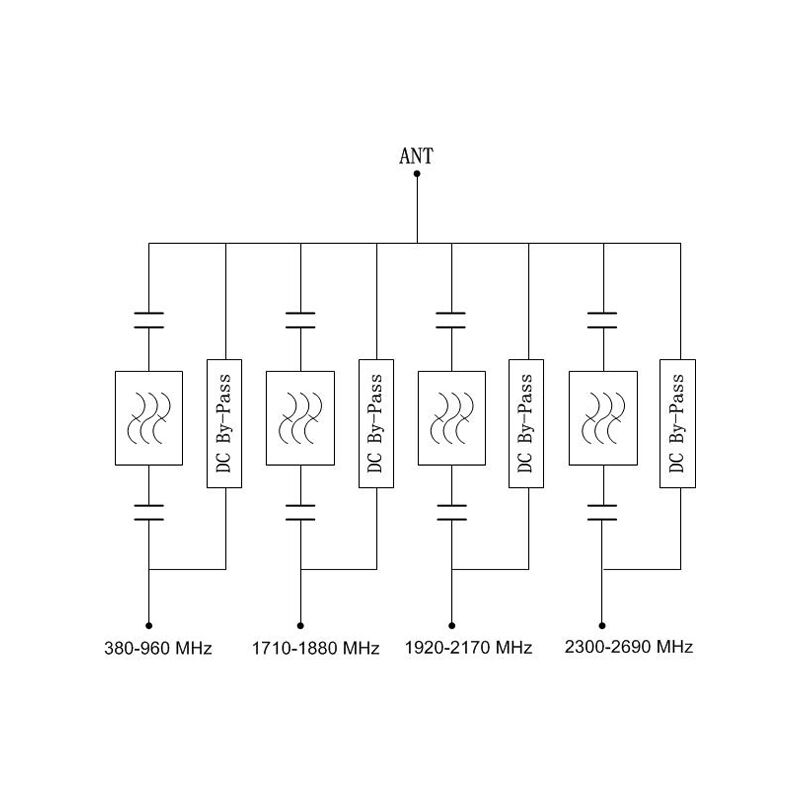
Block Diagram
Outline Drawing
Applications
The combiner is the key RF device to combine multi-band signals in communication system. It is primarily employed in transmitters to combine signals from different frequency bands into a single feeder or antenna, thereby conserving resources and improving system efficiency. The combiner demonstrates excellent performance in terms of low passive intermodulation (PIM) products, low insertion loss, and high isolation, making it suitable for wireless network optimization, In-Building Distribution Systems (IBS), Base Transceiver Stations (BTS), Distributed Antenna Systems (DAS), and Antenna Feeder System (AFS).
The core functions of a combiner include:
1. Signal Combining:
Merging multiple transmit signals from different frequency bands into a single path for transmission through the same antenna, saving antenna and feeder cable resources.
2. Signal Separation:
Splitting received composite signals into different receiving channels according to their frequency bands.
3. Enhancing System Capacity:
Supporting multi-system co-site deployment (e.g., coexistence of 2G/3G/4G/5G networks).
The combiner features the following characteristics:
1. Low Insertion Loss:
Minimizes signal power attenuation during the combining/distribution process.
2. High Suppression:
Exhibits steep filtering characteristics, effectively suppressing interference outside the operating frequency bands.
3. High Isolation:
Prevents signal interference between different ports.
4. Low Intermodulation:
Low intermodulation (e.g., ≤-150 dBc @ 2x43 dBm) ensures no interfering spurious signals are generated under high-power conditions.
5. High Power Capacity:
Capable of withstanding high power from base stations while maintaining linear performance under high-power conditions, preventing performance degradation.
6. Broadband Operation:
Supports coverage across multiple communication frequency bands.
7. Low Voltage Standing Wave Ratio (VSWR):
A good VSWR ensures efficient signal transmission and minimizes reflections.
8. High Reliability and Environmental Adaptability:
Features a passive, robust design with a wide operating temperature range (e.g., -40°C to +85°C), suitable for harsh outdoor environments.
Application Scenarios:
1. Mobile Communication Base Stations:
Enables multi-band antenna sharing, reducing the number of tower-top equipment.
2. In-Building Distributed Systems (IBS&DAS):
Integrates signals from multiple operators to achieve shared indoor coverage.
3. RF Testing Systems:
Integrates multiple signal sources or test equipment.
4. Broadcast Television Transmission:
Combines multi-channel television signals.
5. Military Communication Systems:
Facilitates multi-band signal integration and secure transmission.