EN
EN

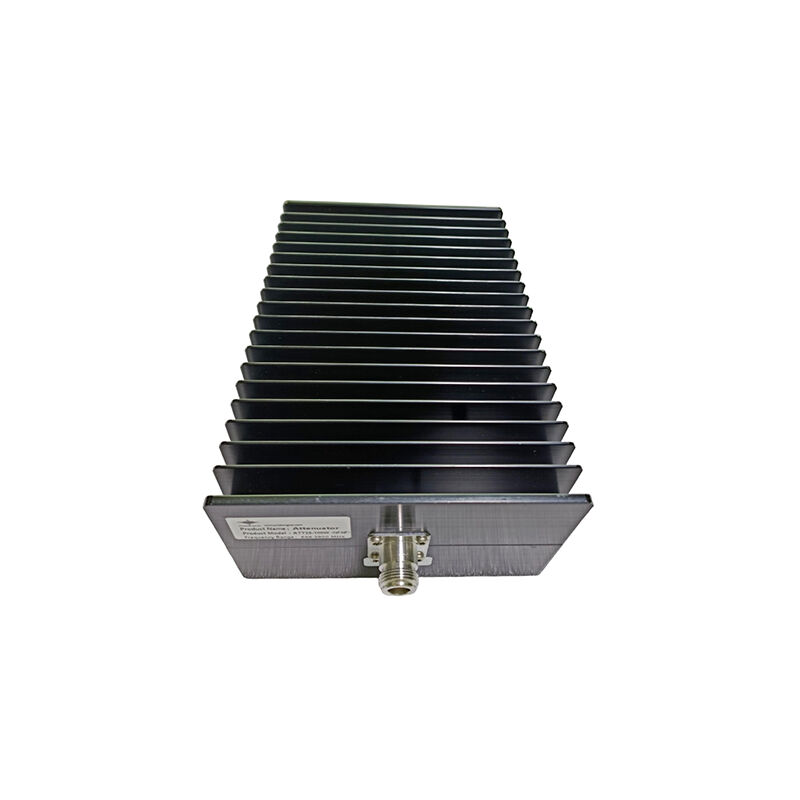
Coaxial Attenuator 698-3800MHz
Product Model: ATT-25dB-100W 698-3800MHz. 120dBc. NF-NF
The Coaxial attenuator is a critical passive device used in radio frequency (RF) and microwave systems. Its primary function is to precisely reduce signal power by a predetermined ratio while maintaining signal integrity and impedance matching. Widely applied in fields such as test and measurement, communication systems, radar, and satellite technology, it serves as an essential component for adjusting signal strength, protecting equipment, and optimizing system performance.
Product Description
♦ Frequency covers 698-3800MHz
♦ High power capacity 100w
♦ Low PIM
♦ Higher reliability
♦ Suitable for indoor applications

- Specifications
- Outline Drawing
- Applications
- Recommended Products
Specifications
| Frequency range | 698-3800MHz |
| Attenuation | 25 dB |
| Attenuation Accuracy | ±1 dB |
| Maximum average power | 100 W |
| VSWR | ≤1.2 |
| Inter-modulation IM3 | ≤-120dBc (with 2 x 43dBm) |
| Impedance | 50Ω |
| Net Weight (Single Unit) | ≤2.76kg |
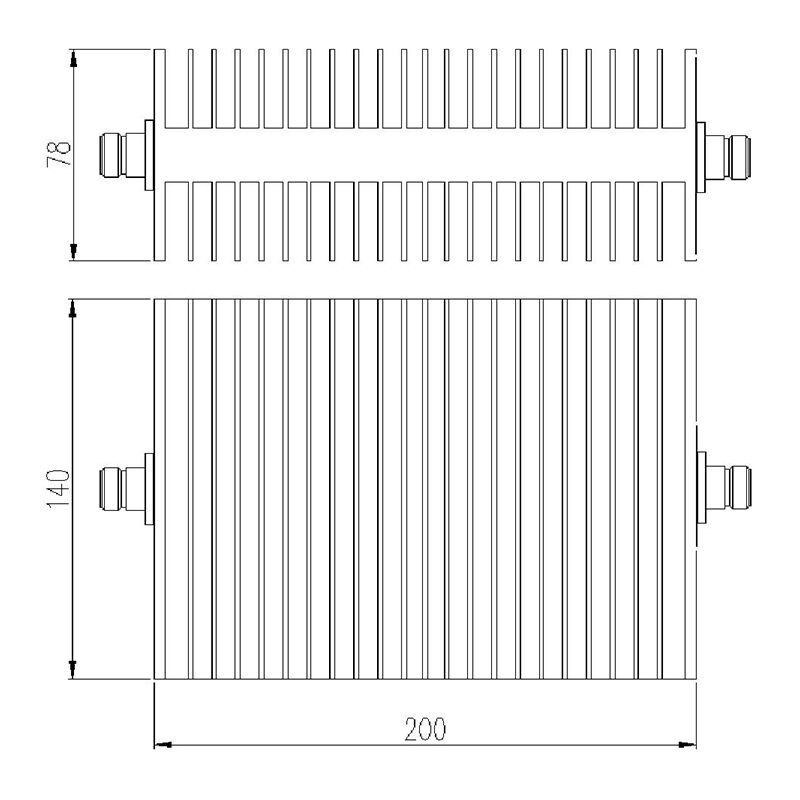
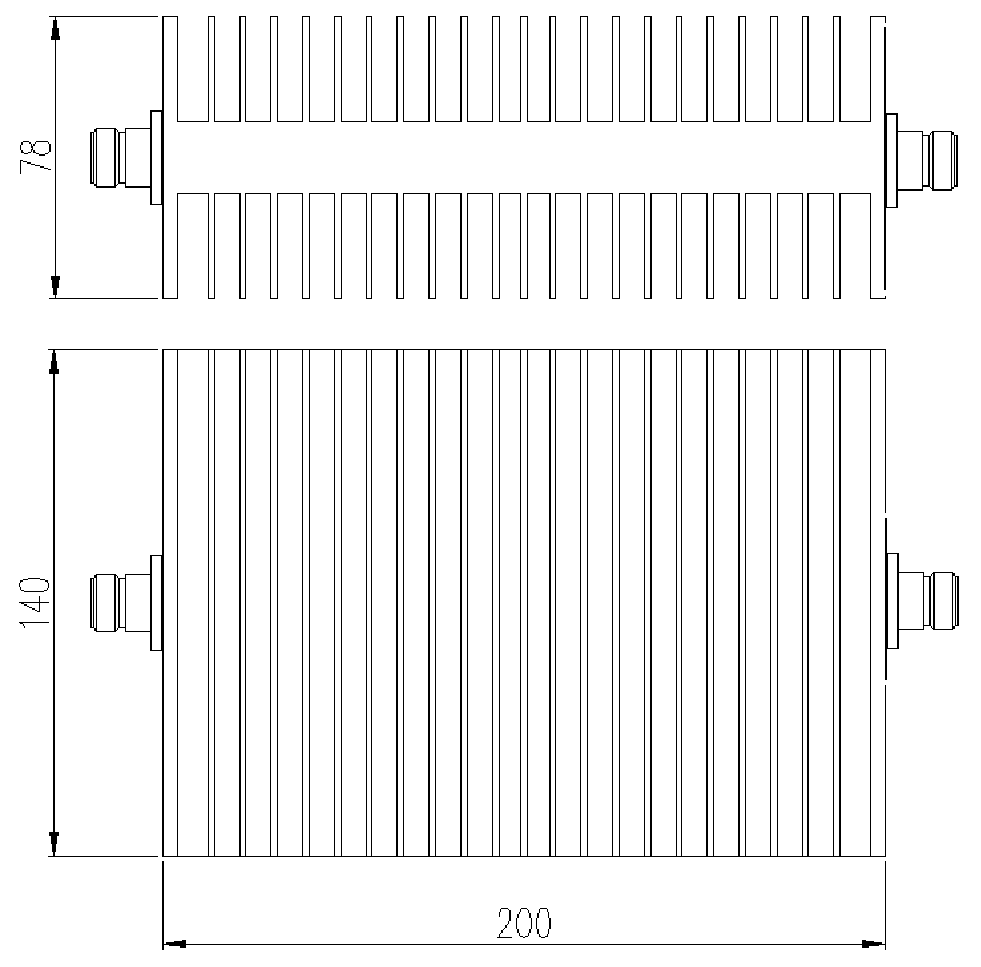
| Dimensions (exclude connectors) | 200x140x78mm /7.87x5.51x3.07 inch |
| Operating temperature | -25℃ to +70℃ |
| RF connector | N Female- N Female |
| Relative humidity | 5~95% |
| Color | Black |
| RoHS | Comply with RoHS |
Outline Drawing
Applications
Coaxial Attenuator Product Description
The Coaxial attenuator is a critical passive device used in radio frequency (RF) and microwave systems. Its primary function is to precisely reduce signal power by a predetermined ratio while maintaining signal integrity and impedance matching. Widely applied in fields such as test and measurement, communication systems, radar, and satellite technology, it serves as an essential component for adjusting signal strength, protecting equipment, and optimizing system performance.
Product Functions
1. Power Adjustment – Accurately controls signal amplitude to prevent equipment damage due to excessive input power.
2. Impedance Matching – Maintains system impedance consistency (typically 50Ω or 75Ω) to minimize signal reflection.
3. Signal Calibration – Used for power calibration of test instruments and compensation of link loss in system pathways.
4. Overload Protection – Safeguards sensitive components (such as amplifiers and receivers) from burnout caused by excessive power.
Product Features
1. Wide Attenuation Range – Attenuation values ranging from 0 dB to over 60 dB (e.g., 0‑30 dB, 0‑60 dB), supporting fine adjustment.
2. High Power Handling – Capable of withstanding incident power from milliwatts to kilowatts (e.g., 1 W, 10 W, 50 W, 100 W).
3. Low Voltage Standing Wave Ratio (VSWR) – Excellent impedance matching performance (VSWR ≤ 1.10:1 or lower), ensuring minimal signal reflection.
4. Broad Frequency Coverage – Supports DC to millimeter-wave bands (e.g., DC‑67 GHz), meeting diverse application requirements.
5. High Reliability – Utilizes precision resistor networks and high‑quality connectors (SMA, N‑type, 2.92 mm, etc.) to ensure long‑term stable operation.
6. Multiple Attenuation Types
· Fixed Attenuators – Provide a fixed attenuation value; simple in structure and stable in performance.
· Variable Attenuators – Allow manual or electrically controlled attenuation adjustment, suitable for dynamic signal control.
· Step Attenuators – Switch attenuation in fixed steps, offering high precision and repeatability.
Application Scenarios
1. Test & Measurement
· Power calibration for signal generators, spectrum analyzers, and network analyzers.
· Link loss simulation and performance testing in radar and satellite communication systems.
2. Communication Systems
· Signal power regulation in wireless network optimization, in‑building systems (IBS), base stations (BTS), distributed antenna systems (DAS), and antenna feeder systems (AFS).
· Overload protection and link balancing in RF front‑ends.
3. IoT & 5G Communications
· Supports multi‑band, multi‑mode signal processing to meet high‑speed, low‑latency requirements.
With precise power control, excellent impedance matching, and broad environmental adaptability, Coaxial attenuators have become indispensable fundamental components in RF systems. Whether in product development, production testing, or system maintenance, selecting high‑quality attenuators can significantly enhance system performance and reliability.